[Blogger’s note: I was born and raised in America, moved to Canada for love in the early Aughts, and recently relocated again, in my 50s, with my British-born spouse to the southern coast of his homeland. This is an occasional series about learning new tricks in Merry Old England.]
Wait, I Have an Accent? How the British React to an Alien Voice in Their Midst
 If you heard me talk, you probably wouldn’t be able to guess right away where I’m from. I was born in Texas and throughout my childhood my family moved all over the American South, from Florida, back to Texas, to Florida again, then to Tennessee and finally to Georgia, where some of my relatives still live. By rights the words I utter should be as drenched in drawl as those of that Clampett clan who loaded up the truck and moved to Beverly—Hills, that is. (Swimming pools. Yada-yada.) Yet due to a fluke of nature, or perhaps congenital obstinance, I’ve resisted the Dixie diction and speak in a voice that is only fleetingly Southern, meaning a twangy syllable might slip out when I’m angry or tipsy, but of course I’m hardly ever either. (Insert winky emoji here.) The rest of the time, it is rather featureless. I asked my spouse to describe my voice and he deemed it “sonorous, uninflected, middle-American.” Notice he didn’t add “irresistibly sexy” and “almost frighteningly macho,” but that’s a topic for another, more private discussion between us. I’m confident in the assertion that, compared to many people from my native region, I have gone through most of my life pretty much accent-free.
Then I moved to the U.K. Continue reading

 When it comes to getting from point A to some faraway point B, I’m an avowed overland man. I get no kicks in a plane, what with fares ballooning in inverse proportion to shrinking seat size and leg room, and airline meals, never Michelin Star-worthy to begin with, now so inadequate that you count yourself lucky if you’re served a lukewarm pizza pocket in a cardboard sleeve. With ships, ferries and other waterborne craft, my fascination is strong but my sea legs and stomach are weak. But take me there on terra firma, via steel wheels or rubber tires, and I’m one happy pilgrim. Some may find the incremental nature of land travel, the steady procession of miles/kilometres one after the other after the other, to be about as exciting as a PowerPoint presentation on navel lint. I find it can be soothing under the right circumstances, traffic jams and jabbering fellow travellers notwithstanding. The opportunity to take in vivid, varied scenery at one’s leisure while allowing the mind precious time to roam, free from distraction, is better stress therapy than a thousand fidget spinners.
 Here I am, 11 months into my first year as a resident of the United Kingdom—how time flies! —and so far in this blog series, I’ve covered various and sundry aspects of my nascent British life, including, most recently, battling
  It’s a question
 “You look to be a man of rude health,” a colleague of my spouse told me when we were introduced at a pub one evening recently. From his genial tone, typical of the Brits I’ve met since moving to the U.K., I guessed that he meant I appeared outwardly robust with no discernible signs of pestilence. But the use of the word “rude” threw me. After all, I was born and raised in the Southern U.S., where rude is never a good thing. He must have noticed the puzzled look on my face because he hastily added, “Oh, sorry, you don’t say ‘rude health’ in America, do you? You say ‘ruddy health,’ I think.” I replied with a noncommittal shrug. After his compliment, I didn’t have the heart to tell him that few Americans apart from jut-jawed New England matriarchs and Teddy Roosevelt have ever boasted about being in “ruddy health.” We’re more partial to “fit as a fiddle,” or “right as rain,” or perhaps just exclaiming “I feel good!” and then attempting a few spirited but clumsy James Brown dance moves.
  “You only have five minutes to order,” cautioned the server at our neighbourhood Japanese restaurant to three newly arrived lunch seekers. “And then you have a maximum of half an hour to finish eating. We do close very soon.” As I gouged at my bento box with chopsticks at a table nearby, the would-be patrons weighed their desire for the restaurant’s good-but-not-great sushi and teriyaki fare against the time constraints and decided to try their luck elsewhere. They shuffled toward the exit, the server following impatiently inches behind. As soon as the last of the interlopers cleared the threshold, he crisply flipped the Open/Closed sign on the door to the latter.
 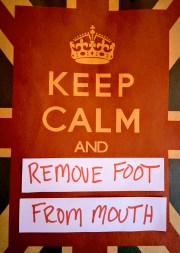 Around the village where we live now, I’m known as “The Dollar Dimwit.”
 dugoutdiscs