[Blogger’s note: In this series, I’m taking the Wayback Machine to a bygone musical era that began with the public break-up of the Beatles and ended with the first Top 40 singles by Prince. My source is Rolling Stone’s best 100 albums of the 1970s, culled from the magazine’s 500 all-time greats by an obliging Reddit user. I’ll focus on selected albums from the list and, if I may be so bold, award Test of Time Points based on how well they’ve held up over the decades, from 1 (stale as old toast) to 10 (still poppin’ fresh) in each case. Enjoy, and rock on!]
#93: Parliament – Mothership Connection (1975)
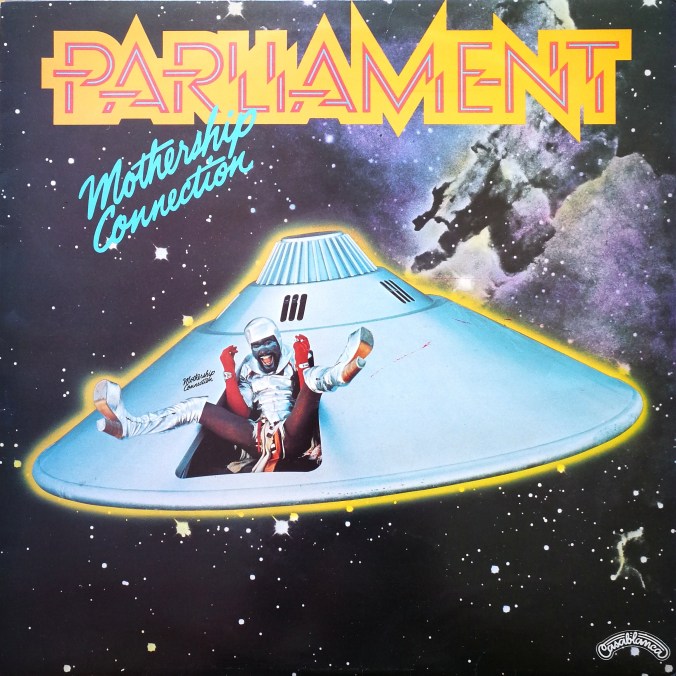
Growing up in America in the mid-1970s, back in the pre-Spotify Stone Age, my go-to sources for new music were the three Rs: radio, record stores, and the roller rink. (Wait, is that four Rs?) Radio gave me my fix of the top pop hits of the day – “Philadelphia Freedom,” “Jive Talkin’,” etc. And as the record stores in my vicinity seemed to be staffed solely by long-haired potheads, I likely experienced my first taste of Pink Floyd and Yes in those hippie havens. But the roller rink is where I got schooled in funk and soul. Savvy ‘70s rink DJs knew that if they wanted to get us kids away from the snack bar and out onto the slick floor for an “All Skate,” they just had to drop the needle on “Getaway” by Earth, Wind & Fire, or “Love Rollercoaster” by the Ohio Players, or Parliament’s crossover smash “Give Up the Funk (Tear the Roof Off the Sucker).” I couldn’t get enough of these rousing rink faves then and I’ve held them close to my heart ever since, even though I haven’t been on eight wheels in decades. Continue reading


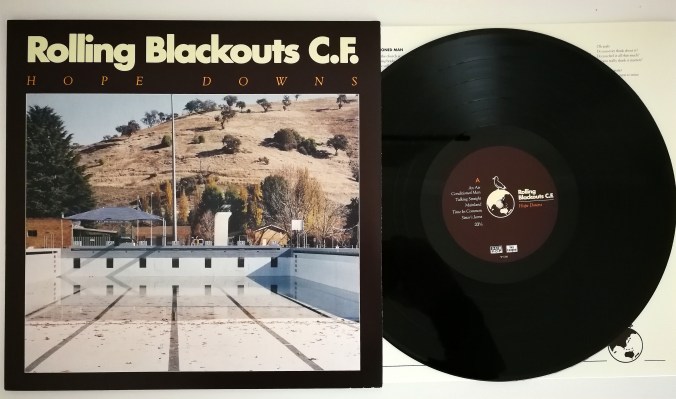
 You know how Harvest Moon is only, like, the ninth or tenth best Neil Young album, and for sure one of his least ambitious, but there are certain times – I’m thinking Sunday at twilight, sitting on the porch and sipping an adult beverage as the sun sinks below the horizon—when its gentle country-folk ditties are all you want to hear? That thought came to mind as I was getting to know The Lookout, the latest solo outing by Colorado singer-songwriter Laura Veirs. Not just because gentle country-folk is well-represented here, by “Seven Falls,” “The Canyon,” and several other exquisitely crafted songs. (Though a few, such as “Watch Fire,” which features feathery counterpoint vocals by Sufjan Stevens, skirt the edges of indie-pop.) It’s also because, while this is most assuredly not the hippest album of 2018 – Veirs is the kind of lyricist who is unafraid to pen a sentimental line like “Man alive, I’m glad I found you” – I can’t think of one that sounds lovelier.
  Serendipity bonded me to the English pop-rock combo Field Music, led by Sunderland brothers David and Peter Brewis, on a sunny afternoon last winter. I’d only recently become aware of the 15-year-old group, having read a rave review of its sixth album, Open Here, in a magazine, and listened to the catchy, lyrically potent single “Count It Up” online. Curiosity piqued, I ambled down to my favourite Portsmouth record shop-slash-eatery
  On paper, the sixth outing by critically adored Brooklyn band Parquet Courts doesn’t seem to support the argument for
  It was love at first listen. My devotion to Elvis Costello started when I wandered into a suburban Atlanta record store at the tender age of 16 and heard This Year’s Model blasting out of the sound system. I snapped up that album, Costello’s second, then and there, and returned to buy his equally brilliant debut, My Aim Is True, the next time I got paid. Dutifully, I purchased each successive release for many, many years, and saw him play live on three concert tours. Other than David Bowie, no solo artist takes up more space in my record collection. But as with any lengthy relationship, ours has had its rough patches. I’m lukewarm about Costello’s forays into genres outside his pop-rock wheelhouse, including classical music (The Juliet Letters) and country (Almost Blue). And sometime after 1989’s Spike, which featured his biggest U.S. hit, “Veronica,” the intensity of my ardour began to wane. In the years since, it’s dulled to a pleasant, comfortable-shoe familiarity. These days, I test-drive his latest efforts via streaming before committing to an LP or CD. I’ve never entertained the thought of “breaking up” with him – he’s meant too much to me in the past for that to happen. But the old magic has gone astray.
  Are these guys for real? That was my first impression upon hearing Greta Van Fleet’s full-length debut, a suspiciously spot-on paean to 1970s arena rock. “Age of Man” kicks off the album with an intro of pretty strings and flutes, evoking wandering minstrels at a Renaissance Fair. Then Joshua Kiszka’s voice, which rivals Rush’s Geddy Lee and Led Zeppelin’s Robert Plant in its lofty pitch, pierces the pastoral mood. “In an age of darkness, light appears,” Kiszka, 22, screeches, sounding for all the world like a leotard-clad, codpiece-stuffing rock star from the era of lava lamps and gatefold album sleeves. The rest of the band – Josh’s twin bro Jacob Kiszka on guitar, younger sibling Sam Kiszka on bass, and family friend Danny Wagner on drums – enters with a prog-rock wallop and we’re off with a sound that borrows a bit from Rush and similar groups and a whole lot from Led Zep. It’s all alarmingly reminiscent of a bygone musical style that fell out of fashion the moment the Ramones played their first gig at CBGB’s. So, these many years later, in an age when irony is king, one can’t help but ask, seriously, are these youngsters pulling our legs?
  dugoutdiscs